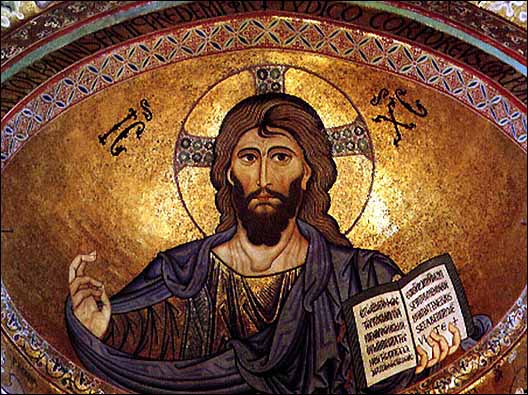
 Christ Pantocrator Byzantine mosaic
 To this question, Dr. Leon J. Podles says yes without any ambiguity in his book The Church Impotent : The Feminization of Christianity ("church impotent: the feminization of Christianity"). The author observes that in all the Western churches (Catholic and Protestant), parishioners are mostly ... of parishioners. Generally in Europe and America, men go to church because their wife, their mother or the girlfriend is forced. West, among the faithful going to mass, the ratio of women to men is about 3 per 1, despite the correction due to age! More church is considered liberal (ie left) and more men are a minority. Conversely, the author notes that the sex ratio is more balanced in the Orthodox churches ("the only Christians to still wear beards") or even become predominantly male among Muslims and Jews. Podles cites several studies showing that men more attracted by the Christian priesthood are those with the most feminine personalities:
We are far from the crusaders and inquisitors of the Middle Ages! But why European men, especially the male, they are not attracted by religion? This trend she proceeded to u or is it Christianity emerged in the course of history? The author leans toward the latter.
He said that the idea of personal union with Christ, popularized by Bernard of Clairvaux (after Origen) and mystics such as Teresa of Avila, who is the manager. Unlike Judaism and Islam where God is a stern father who wants to and must be obeyed, the god of the Christians from the second millennium the union wants the merger of the "bride of God" (the Church) and of Christ. Bogeyman of God turns into a comforting mother, with a parallel rise of the cult of Mary. Of Christ Pantocrator ("Almighty") surrounded Uranian glory in the early Byzantine mosaics of inspiration, Christ is increasingly dependent upon his mother in Western iconography, becoming the famous "little" Jesus, baby chubby and innocent, warm in the arms of Mary. The development of this aspect has particularly appealed to women, and we see the author as an explosion of female orders during this period. Conversely , this aspect is particularly repulsive to the male mentality, whose basic nature is separate from the female die to acquire its own existence.
 Virgin and Child
The male mind dreams of glory, conquest (in every sense), struggles, a life eternal of fun and feasting to celebrate the Elysian Fields, or at Valhalla, not a merger with the quasi-uterine Grand All, the matrix, the foster mother or the Church. Symbolically, Cronos, the ultimate male, father of Olympian gods breaks (to the tune of obsidian sickle) the merger of his father Ouranos and Gaia her mother so that the world can exist. That may be why other Christian denominations recent, like the Mormons emphasize on life after death more prosaic, the immortal man have his own worlds to colonize and develop, to a scale much greater than ours. The mere idea of being stifled for eternity in the arms of a sweet Pure Love of God causes only very mild enthusiasm among many men, and only a theological revolution may bring the goats lost to the fold.
"Because Christianity is now seen as partly due to the male rather than female sphere, it sometimes attracts men whose masculinity is rather dubious. For men with masculinity "dubious", I do not imply homosexuals, although a certain type of homosexual could be included. I would rather say that religion is seen as a safe haven, a refuge against the challenges of life, and so it attracts people frightened at the idea of separating from the protected world of childhood, dominated world women. These men have problems to follow the path of male development. Among Catholics, it is also a truism to say that the priests chose the priesthood because of the influence of their mother, and that many priests are very close emotionally to their mothers more than men, including their father. "(Translation Vertumnus)
We are far from the crusaders and inquisitors of the Middle Ages! But why European men, especially the male, they are not attracted by religion? This trend she proceeded to u or is it Christianity emerged in the course of history? The author leans toward the latter.
He said that the idea of personal union with Christ, popularized by Bernard of Clairvaux (after Origen) and mystics such as Teresa of Avila, who is the manager. Unlike Judaism and Islam where God is a stern father who wants to and must be obeyed, the god of the Christians from the second millennium the union wants the merger of the "bride of God" (the Church) and of Christ. Bogeyman of God turns into a comforting mother, with a parallel rise of the cult of Mary. Of Christ Pantocrator ("Almighty") surrounded Uranian glory in the early Byzantine mosaics of inspiration, Christ is increasingly dependent upon his mother in Western iconography, becoming the famous "little" Jesus, baby chubby and innocent, warm in the arms of Mary. The development of this aspect has particularly appealed to women, and we see the author as an explosion of female orders during this period. Conversely , this aspect is particularly repulsive to the male mentality, whose basic nature is separate from the female die to acquire its own existence.
 Virgin and Child
 The male mind dreams of glory, conquest (in every sense), struggles, a life eternal of fun and feasting to celebrate the Elysian Fields, or at Valhalla, not a merger with the quasi-uterine Grand All, the matrix, the foster mother or the Church. Symbolically, Cronos, the ultimate male, father of Olympian gods breaks (to the tune of obsidian sickle) the merger of his father Ouranos and Gaia her mother so that the world can exist. That may be why other Christian denominations recent, like the Mormons emphasize on life after death more prosaic, the immortal man have his own worlds to colonize and develop, to a scale much greater than ours. The mere idea of being stifled for eternity in the arms of a sweet Pure Love of God causes only very mild enthusiasm among many men, and only a theological revolution may bring the goats lost to the fold.


0 comments:
Post a Comment